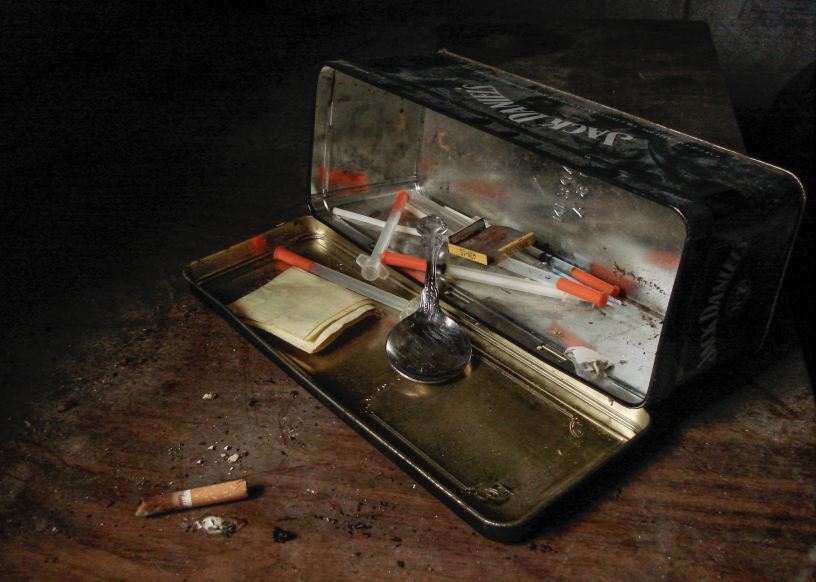
The first time John smoked crystal meth, he didn’t know what it was. “One day, this guy said, ‘Here, smoke this,’” says the 29-year-old preschool teacher, who wished to be identified only by his English name. “I didn’t know what it was, but I tried it anyway.” That wouldn’t be the last time John used meth. John, who lives in Beijing, says he became addicted three years ago during a low point in his life. “My girlfriend had broken up with me. I felt unhappy because I didn’t earn enough money in my job and I had no friends. I felt extremely lonely.”
At the same time, John had begun grappling with the realization that he might be gay. After finding a group of gay men, he started spending all his time with them, anxious to fit in. “I put most of my energy into that gay group,” he says. According to John, meth is widely used in China’s gay community to enhance sex—sex that is often unprotected. Eventually, John contracted syphilis. Desperate to turn his life around, he sought out a Beijing chapter of Narcotics Anonymous. “My sponsor tells me that addiction is a disease. I’m not responsible for my disease, but I’m responsible for my recovery. That really helps me.”
John is part of a growing number of young people in China who have started using illegal drugs. According to a report released by the China Food and Drug Administration for 2016, 51.7% of all of China’s drug users are under age 35. The drugs of choice for these younger users are synthetic drugs like meth, with 43.3% of synthetic drug users having begun using before they were 25. Overall drug use in China is going up as well. The number of drug users on record rose 7% from 2015 to 2016, according to a report by China’s National Narcotics Control Commission.
How will China choose to deal with a new generation of addicts like John? In the past, anti-drug policies have focused on squelching drug use through harsh deterrents, rather than on treatment or recovery services.
This approach is partially the result of a 2008 Anti-Drug Law, which called for illegal drug users to receive rehabilitation treatment in professionally staffed, compulsory detox centers for 2-3 years, and for continued “community-based treatment” to be administered post-release. Initially, this law was thought to represent a more “human-centered” approach to drug enforcement. However, according to a report entitled Where Darkness Knows No Limits by international NGO Human Rights Watch, in practice the law actually “expands police power and removes legal protections from people suspected of drug use.” Moreover, the report describes compulsory detox centers as little more than labor camps run by police, with no drug treatment or counseling offered. As stated in the report, “Former detainees in Yunnan told Human Rights Watch that while in drug detention centers they were beaten and made to work up to 18 hours daily in wretched conditions without pay. Multiple sources told Human Rights Watch that detainees are consistently denied access to basic medical care.”
Xiao N (alias), a former drug user who now works with a non-profit to assist current and former users, spent two years at a compulsory detox center. In 2009 he was caught using and was sent to the Heavenly River Compulsory Quarantine Drug Detox Center in Beijing, where he was put to work making plastic components for electronics. Xiao N says that people were often beaten in the center and given shocks from electric batons as punishment, sometimes with several batons at once. “I will never forget the Pop, Pop! and the sound of screaming until the day I die,” he says.
Xiao N says that during his time there, little treatment was offered in the facility. He says that there were some police officers who had received certificates for completing mental health training, but there were no actual mental health professionals on staff. Occasionally some professional mental health experts would come hold group activities, but only a small number of people could attend.
Xiao N believes that conditions at the Heavenly River Compulsory Quarantine Drug Detox Center were harsher than at other facilities because it was formerly a “re-education through labor” camp. The re-education-through-labor system was started in the 1950s and was highly criticized for allowing police to detain petty criminals for years without trial. Inmates in the system were forced to perform factory work without pay. The re-education-through-labor system was officially abolished in 2013, but many re-education-through-labor camps have simply been converted into compulsory drug detox facilities, with inmates reporting that little has changed in terms of conditions.
In addition to harsh punishments within the compulsory detox centers, former drug offenders also face tremendous challenges after their release. Drug offenders have their status recorded in a national database linked to their national ID cards. This makes getting a job nearly impossible. Moreover, when former drug offenders use their ID card, such as when checking into a hotel, police can arrive to conduct a random drug test. Drug offenders say that the police often disregard privacy concerns, frequently demanding these drug tests in front of family or coworkers. “Look at me. I’ve been sober for many years—10 years—and I am still not willing to use my ID card,” says Da Peng (alias), a former heroin user who now works with Xiao N assisting drug users. “Many people use fake ID cards . . . Because of this database some people can’t return to society,” he says. Under the law, these random drug tests should only continue for three years, but in practice they go on much longer.
Cultural Differences Regarding Forced Treatment
For organizations like Human Rights Watch, the offending issue isn’t only the conditions within the compulsory detox centers, but also the fact that they are not voluntary. In their report they advised government departments to “immediately shut down compulsory drug detention centers and provide voluntary, community-based outpatient drug dependency treatment for people who use drugs.”
This is also the position taken by a 2012 joint statement signed by twelve United Nations Agencies, including the World Health Organization. The statement called on member states to immediately close compulsory drug detention centers, and asserted that, “All health care interventions, including drug dependence treatment, should be carried out on a voluntary basis with informed consent, except in clearly defined exceptional circumstances in conformity with international human rights law that guarantees such provisions are not subject to abuse.”
But many within China feel that compulsory treatment is necessary to protect the rest of society. Wu Zunyou, an official with China’s Center for Disease Control and a consultant to the UN, wrote in response to the UN joint statement that compulsory drug treatment should be part of a broader harm reduction strategy, specifically for opioid-dependent individuals. For him, it’s a question of cultural values. “In general, Western societies defend and protect individual rights over the rights of the broader community, while the opposite is true of Eastern societies,” he writes. In his opinion, “opioid dependence should not be viewed solely as a medical issue affecting the individual, but rather, as a complex social problem that affects entire communities.” For people like Wu, compulsory detox centers in China may have problems, but the issue is not that they are compulsory.
Even some former addicts who spent time in the compulsory drug detox centers agree. Shanshan, a former heroin user who gave only her first name, says that the center was what she needed to finally get clean. The Beijing-located center was run by the Public Security Bureau, and according to her account, had much better conditions than those experienced by Xiao N at the former re-education-through-labor camp. Shanshan says that there was no forced labor, and she never saw anyone get beaten. She was able to participate in activities at the center, such as managing the center’s library and studying chalk art.
The center also held regular, boot camp-like military exercises, which Shanshan believes created a good environment for her to recover. “I think being at the center helped me a lot. I say that because most people who do drugs are used to a lazy, careless life . . . I used to be very self-centered and undisciplined. I really think everyone needs to experience some discipline, some regular structure—a soldier-like experience. So, for me I think it was very helpful.”
Former user Da Peng agrees that China’s harsh penalties have been effective at deterring people from using drugs, but he believes the cost was also very great. He says that heroin use has decreased dramatically in the 20 years since he began using, in part due to the government’s policy of separating drug users from the rest of society. “In terms of heroin this policy has succeeded. But it was not without a large sacrifice. A small group of people were sacrificed for the majority. They didn’t care about human rights, they didn’t care about people’s freedom.”
Da Peng says that there must be another solution, one that emphasizes treatment over punishment. He maintains that addicts shouldn’t be treated like criminals. “If you treat someone like a criminal, they become a criminal,” he says.
 Articles By Roma Eisenstark
Great Article! Poor kids everywhere.
LikeLike