This article originally appeared in City Weekend on August 29, 2017.
Throngs of people crowd the convention center. A steady roar of giggles, J-Pop, and clicking camera shutters echoes against the airplane hangar-like metal ceiling. Early in the day at the 2016 Beijing Comic Con, the excitement is palpable. Devotees march purposefully from booth to booth, clutching camera phones and brightly colored shopping bags. Occasionally, an Iron Man or a Snow White walks by, stopping for photos or to rest feet worn by heels and aluminum footwear.
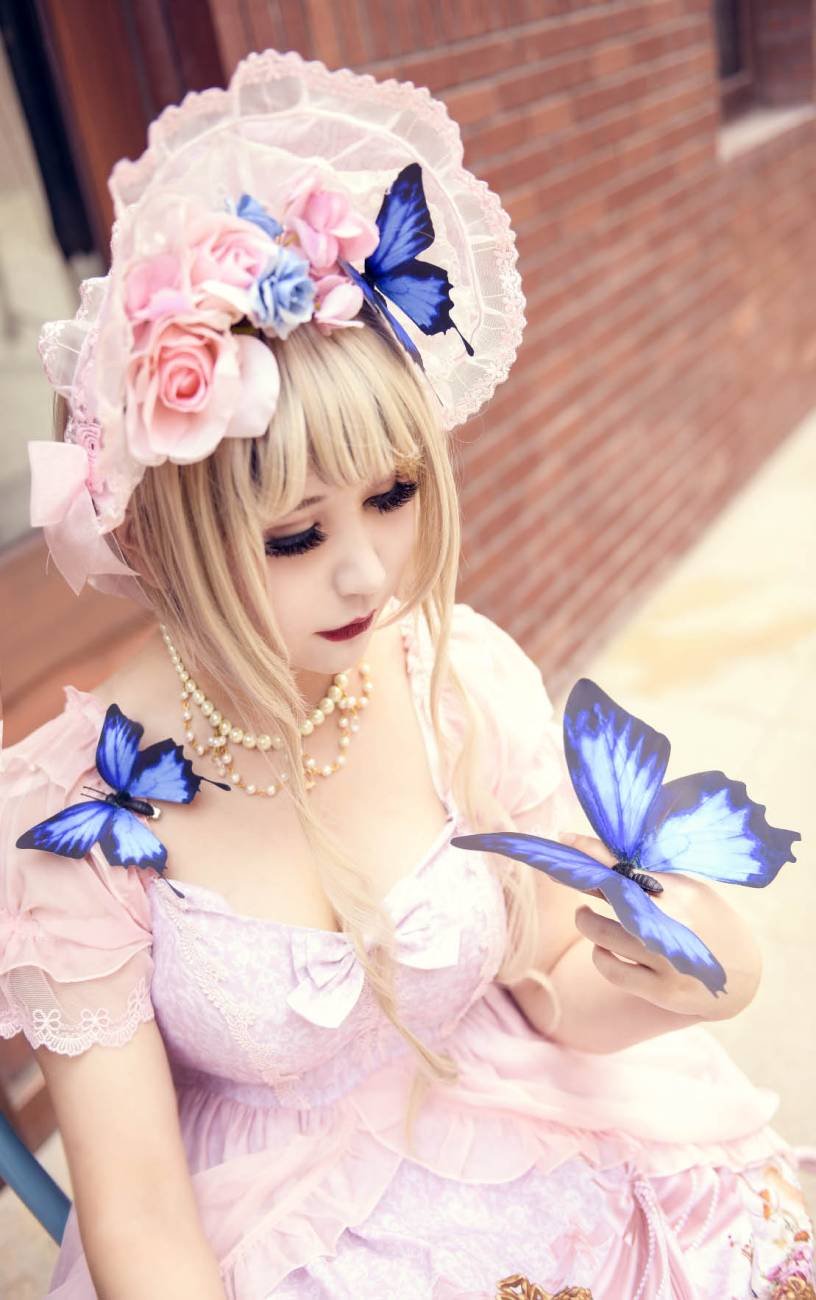
Aside from the Disney princesses and Marvel heroes, a group of young women begin to stand out from the crowd. Like porcelain dolls, they are covered in layer upon layer of petticoats, their voluminous skirts bumping each other as they pose for photos. On their heads sit curled wigs, ribbons, and elaborately decorated little hats. Lace seems to pour out of them.
“Hi girls, you look great! Can I ask you some questions about cosplay?” A woman in ordinary clothes walks up to them, camera in hand. They look at her for a moment with irritation. “We’re not cosplayers…” they finally say. “We are wearing Lolita fashion.”
Lolita fashion, or Loli, for short, came out of Tokyo street fashion in the 1990s. The style takes French rococo (think Marie Antoinette) and combined with Japanese kawaii cuteness to create something that is not quite European, not quite Japanese, not quite modern, and not quite old.
Within the style there are many sub-genres—each with their own community of admirers. Sweet Lolitas wear pastel prints of cupcakes, baby animals, and merry-go-rounds. Classic Lolitas look more traditionally European, like Victorian children at a garden party. Gothic Lolitas combine the dark Japanese goth look with nineteenth-century dresses to create something reminiscent of an unintimidating, old-timey vampire. There is even a Chinese Lolita which takes a traditional qipao, and puffs it out at the waist to accommodate a flora of petticoats. Of course, this is not to mention the slew of accessories from bonnets to stockings, purses to fake eyelashes.
“It’s girly and lovely—as the Japanese say, kawaii! Just like myself, I think,” says Zhao Yanchen, a recent PhD graduate and Lolita devotee. And for Zou Miao, who sells her specially designed Lolita accessories online, it was love at first sight, “When I was in middle school, I saw some advertisements that had women wearing these kinds of dresses, and I felt so envious! Because in China, in middle school, there are specific requirements for girls’ clothing and hairstyles. You can’t wear anything that extravagant. So at the time, I really longed to wear such glamorous outfits.”
Regular “tea parties” give Lolitas a chance to meet, build community, and show off their dresses. Hu Xiaowen, who works in advertising, says the population in Beijing is large and growing. “We have around, I’d say 500 people just in Beijing. And the majority of them are girls, but we do have boys.”
Boy Lolitas—known as “Brolitas”—don all the same dresses, wigs, makeup, and accessories as the girls. Some guys, however, choose to dress in “Boystyle,” a more traditionally masculine look that is often considered the male-fashion equivalent of Lolita. Similar to Lolita, Boystyle combines eighteenth and nineteenth-century European tastes with kawaii aesthetics. Instead of hooped skirts, it utilizes tailcoats, top hats, and puffy riding pants. Boystyle also has its own sub-genres, such as Dandy, Ouji, Kodona, and Aristocrat. And of course, just as Brolitas defy gender norms by dressing in Lolita, many women dress in Boystyle as well.
The reasons why guys get into Lolita seem not all that different from the girls.“Why do I like Lolita? Lolita fashion is beautiful. All people love beautiful things, don’t they?” says Hong Chuan (not his real name), an 18-year-old student in Shenzhen who recently got into wearing Lolita dresses. “I used to buy many Boystyle outfits,” says Duvet (also an alias), a 30-year-old software engineer, “but I came to feel that only a dress could truly express Lolita’s cuteness and magnificence.”
The Brolitas we talked to identify as cisgender, straight males. Duvet says he knows some Brolitas who are gay, though he personally doesn’t believe there is much of a connection. Married for many years, he got his wife into Lolita. Together they attend Lolita events and, because they wear a similar size, share dresses.
At the same time, the Brolitas we spoke with said that wearing Lolita can help express their feminine side. According to Duvet, “I don’t think anyone is absolutely 100- percent male or female, everyone has both sides. … although I am a man, I have some delicate, or gentle sides.” Hong Chuan agrees, “My personality has some more feminine aspects—I am more shy and introverted. When wearing Lolita, I can experience something of what it’s like to be a woman.”
Of course, when people in the West hear the name Lolita, most assume that it is some sort of fetish play. All the Lolitas we spoke to, however, were adamant that this is not the case.
“Most girls who wear Lolita wear it because they like it, not to attract men,” says Zhao. In a letter to the feminist site Jezebel, one Lolita wearer defended the style, writing, “It’s not, as some commenters have suggested, some sort of appeal to men’s expectation that women should be childlike, or an attempt to pander to pedophiles. Pedophiles like little girls. They don’t like grown women who happen to like dresses with cakes on them.”
So why the name? No one really knows where it comes from, though some speculate it might have been an unfortunate Japanese misinterpretation of Vladimir Nabokov’s famous novel—an Engrish accident of epic proportions.
In Asia, Lolita fashion is also controversial, but for different reasons. In China and Japan the fashion’s biggest transgression is not how it treats women, but rather its willingness to fly in the face of social conformity. One girl, we met at a manga convention said that her mother discouraged her from wearing Lolita because she said it could be dangerous for people to notice her on the street.
Hu says that negative attention from outsiders has caused them problems in the past. “Sometimes we get offended by other people because they don’t know about this culture or they call you a weirdo. Especially in China, people are not very comfortable with you wearing something that’s in a light color or very strange.”
At the same time, making the decision to stand out against this backdrop can also be very empowering. Hu says that Lolita even has the power to change lives. “It brings out the confidence inside you. Because you have to show what you really like and what you really want to be, in front of everyone. Instead of like some people, especially Chinese, they kind of hold back and conceal themselves from other people.”
Zhao agrees. “In China, the young people—they think this is a way to express themselves. In Chinese history, there is a long tradition of not supporting individuality. But from the 1970s onward people started to believe that individuality was important, and people started to gradually open up. Younger people are more accepting of this idea.”
Zou says Lolita has had a big impact on her life. “In everyday life, I am a shy, introverted person. To tell you the truth, I look very average. But when I put a dress on for the first time I felt like I looked very interesting, very beautiful. I found my self-worth.”

Appeal Beyond Apparel
The Lolitas we talked to all said that what they do is entirely different from cosplay. “It’s costume for a cosplayer, but it’s clothes for us,” says Hu. Yet, like costume, there is clearly an element of fantasy involved. Vilorrie, who also works in advertising, tells us, “Whenever I wear this style, I fantasize that I am a Victorian-era aristocratic lady, or a wealthy maiden from Chinese antiquity. This fantasy is of course just a way to satisfy my young girl heart, or a way to imagine having a fine, elegant life. After all, every girl has likely fantasized about being a princess when they were young.”
Professor Masafumi Monden, who studies fashion and culture at the University of Technology, Sydney, also recognizes the fantasy appeal of Lolita. In an essay entitled, “The Nationality of Lolita Fashion” he wrote, “For some who wear this style, Lolita is not merely a choice of clothing, it also defines their identity and lifestyle. Their fashion and demure body language are closely associated with romantic views of privileged young women in the idle, aristocratic, elite social classes of eighteenth- and nineteenth-century Europe.”
Sophia Staite, who did extensive research interviewing Lolitas in Australia, found that many of them came from working-class backgrounds and liked to fantasize about a different kind of life. One of her subjects told her, “Fashions used to be a mark of status. Both men and women of the upper classes would wear elaborate and pale-colored clothes to make it clear they had no work that would threaten the integrity of their delicate fashions, no dirty work. So sometimes it’s nice to pretend to be glamorous and decorative and far away from work.” Interestingly, while Japanese Lolitas often fantasize about nineteenth-century Europe, Staite found that many Lolitas in Australia dreamed of present-day Japan.
Some Lolitas also express a longing for a pre-industrialized fashion. Duvet, one of the Brolitas that we spoke to, told us, “Nowadays the clothes that you usually see people wearing, like T-shirts and jeans, they look very industrialized—cold and technological. Even though sometimes they have some decoration, utility is the priority. It feels very rational, it doesn’t feel welcoming. But Lolita fashion has lace boarders and decoration … a person who wears lots of lace and adornments—I feel that this person is more amiable, more likable.”
A Young Person’s Fantasy
Most scholars believe that the concept of adolescence developed in Japan in the late nineteenth century along with the Meiji Restoration’s push for industrialization and universal education. School attendance rates shot up and more children, including girls, stayed in school longer. It was during this era that the concept of shōjo—a period in a woman’s life after childhood but before adulthood—was born. The term shōjo literally means “young woman” but is now often used to refer to a teenage girl who acts with kawaii mannerisms. Shōjo manga—manga targeted at teenage girls—has had a significant influence on Lolita fashions.
The majority of Lolitas around the world seem to fall into this age group. “Our biggest group of customers are college and high school students, followed by people who are working,” says an employee of Fairydream Lolita in Guomao, the only brick and mortar Lolita store in Beijing. Hu says that many of her friends quit Lolita after graduation. “The atmosphere stays when you are in college. After graduation, when you step into society, everything seems different.”
Isaac Gagné, an assistant professor of anthropology at the University of Hong Kong who spent extensive time with Japanese Lolitas, said that of the 26 Lolitas he interviewed, nearly 50 percent became interested in Lolita during high school, and 30 percent during middle school. When he returned to Japan to conduct follow-up interviews four years later, he discovered that most of his informants had quit wearing Lolita once they married or found jobs.

For young women who will soon be facing new responsibilities in adulthood, fantasizing about a carefree, childlike existence can be appealing. In an essay entitled, “Bracketed Adolescence: Unpacking Gender and Youth Subjectivity through Subculture Fashion in Late-Capitalist Japan,” Gagné argues that enjoying the fantasy of Lolita is a way to temporarily prolong childhood before taking on adult responsibilities. He writes, “Lolita informants were indeed conscious of the fact that their time to pursue such aesthetics and activities was limited, and that the norms and expectations of adulthood were waiting for them.”
Gagné says that for Japanese Lolitas, the style was seen as “the farthest away from the adult world and social responsibility.” This is likely because Lolita is often thought of as extremely self-indulgent. Laura Abbott, who wrote her honors thesis at Washington State University on the concept of shōjo, writes, “The kawaii shōjo intent on frivolities is interpreted as a cutesy way of saying, ‘I’ll do what I want,’ to larger societal responsibilities. In a culture where the embodiment of morality can only be achieved by addressing larger societal needs and duties, attending only to the needs of the self is a grave statement about the perceived usefulness of traditionally-held Japanese values.”


Zhao Yanchen. Photo: Tao Zi
While the embodiment of morality is clearly defined differently in the West, the idea of using a hobby to postpone adulthood is not foreign to most Westerners. One can think of fraternity pranks, your college Quidditch team, or going to Burning Man when you’re 22 as last-hour youthful indulgences that likely won’t be acceptable later in life.
Of course, many do continue to participate in these types of subcultures longer into adulthood. Similarly, not all Lolitas give up the style when they hit a certain age. Several of the Lolitas we spoke to were already working. Hu, who has started her career, says she has even met Lolitas over the age of 50. “But they don’t look 50 years old because this style is very sweet … I want to be that kind of woman!” Clearly, some Lolitas are confident enough to pursue “the needs of self” longer into adulthood than others.
Gagné argues that like Western teenage indulgences, Lolita fashion has become highly commodified. Feng Guorui, co-owner of Fairydream Lolita, said that her store’s domestic-brand dresses typically run from ¥300-500. Japanese labels, on the other hand, can be anywhere from ¥1,000-3,000.


Pu Yaoqi shows off her Soft-style Lolita look. Photo: Tao Zi
Candy-Colored Feminism?
The individualistic nature of Lolita might also serve to reinforce female autonomy. Feminist blogger and Lolita fan Stephanie Davies wrote in her blog Gliterature that “Lolita is also a threat to traditionally patriarchal values because it exists to the exclusion of men. These girls/women aren’t dressing this way to ‘get a husband’. These costumes are not created to please others, dressing Lolita is an almost entirely self-indulgent practice. This can be quite a novelty for those individuals who assume that ‘every single action in a woman’s life is entirely based around how she feels about the men in her life.’”
Zhao reinforced this point when she told us, “A woman’s choice deserves others’ respect because it is her choice. The feminism of Lolita comes from the fact that it’s one’s own choice. Women themselves decide what they want to become, and they don’t care about the judgment of others.” Lolita isn’t intended as a statement against the patriarchy, but its complete lack of concern for the reaction of men is perhaps a statement in itself.
Hence, for many, the fantasy of Lolita is a brief escape before taking on the responsibilities of adulthood. It is a celebration of the West, both in terms of its idle, aristocratic past, and its individualistic present obsessed with self-expression. Yet, however brief, that foray into self-expression can have a powerful effect on young Lolitas.
As Zou tells us, “Now, when I stand in front of a camera or in front of a mirror, I feel a sense of pride. That pride has entered my life and made me more confident. I was able to make more and more friends. Together we can discuss Lolita and dresses, and every aspect of our lives.”
 Articles By Roma Eisenstark